
Emergency funds help individuals cope with the unexpected financial challenges that life frequently throws at us.These situations often arise when we least expect them: a child suddenly falls ill, a loved one dies unexpectedly, or a car accident occurs.
Setting some money aside could be the difference between managing such unexpected situations calmly and falling into financial difficulty.
What is an Emergency Fund?
An Emergency Fund is money set aside to cover unforeseen expenses or major life disruptions, such as medical emergencies, job loss or urgent repairs. A common target is to save enough to cover three to six months of essential living expenses, although the appropriate amount depends on an individual’s circumstances and income.
Understanding the 50/30/20 Budget Rule
One practical way to plan for emergency funds is to incorporate them into a monthly budget. The 50/30/20 budgeting rule provides a simple starting point.
U.S. Senator Elizabeth Warren and her daughter, Amelia Warren Tyagi introduced and popularised a savings concept called the 50/30/20 budget rule through their 2005 book, All Your Worth: The Ultimate Lifetime Money Plan The rule provides simple guidelines for dividing after-tax monthly income into three main categories.
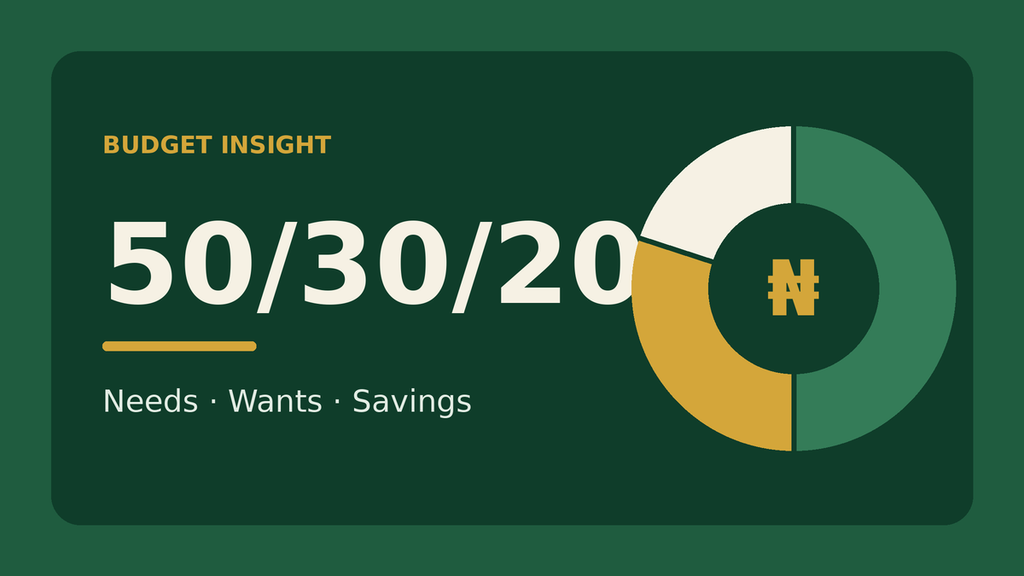
•50% for Needs: These are essential expenses required for daily living, such as rent, basic groceries, utilities, including water, electricity and gas, and healthcare.
•30% for Wants: These are non-essential expenses that improve your quality of life but are not necessary for survival. Examples include dining out, hobbies, entertainment, and vacations.
•20% for Savings and Financial Goals: This portion of your income goes towards building an Emergency Fund, Investing for the future, and paying off debt.
Saving 20% of your monthly income can be challenging in Nigeria’s current economic climate, where the rising cost of living puts pressure on household budgets. This challenge becomes more evident when we consider the minimum wage earned by many Nigerian workers.
Even with a regular income, meeting essential expenses on a limited salary can be difficult, particularly for those who have to pay rent, feed their families and cover transportation costs. For such individuals, setting aside 20% of your monthly income may be unrealistic.
Nevertheless, this 50/30/20 budgeting rule should not be viewed as a rigid financial principle. Instead, it should be seen as a flexible guideline that individuals can adapt to their financial circumstances as they work towards greater financial stability. Individuals whose incomes are barely sufficient to cover their essential expenses may need to begin by saving a smaller percentage of their earnings and gradually increase it as their financial circumstances improve.
The most important thing is to develop a consistent savings habit while working towards a more sustainable financial position.
Ultimately, successful budgeting is not about following a fixed formula but about making informed financial decisions that support your needs today while helping you build a more secure future.
Leave a Reply